
Annual Report 2025
Red Cross Red Crescent Climate Centre
We sat down to write this as US scientists were rating a new El Niño as a virtual certainty by February 2027 and our teams were readying for the possibility of what the media are calling a “super El Niño”, preparing focused scientific advice to different parts of the Red Cross Red Crescent Movement.
El Niño, of course, is a natural phenomenon, but it complicates and exacerbates the impacts of human-generated climate change.
Shifts in ocean temperatures across the Pacific under El Niño conditions result in a higher-than-normal global temperature, making our ongoing work on the heat hazard still more relevant, especially in vulnerable and marginalized communities.
A highlight of 2025 was our joint report with the IFRC secretariat on heat “seen through the eyes of the most vulnerable” – anchored in an analysis of bottom-up data on the daily experience of heatwaves of vulnerable city-dwellers worldwide.
An anniversary snapshot report on Paris 2015 from World Weather Attribution that we participated in – Ten Years of the Paris Agreement: The Present and Future of Extreme Heat – found that with the current projected 2.6°C of global warming, we’re looking at nearly 60 extra hot days a year compared to now.
The financial headwinds strengthened apace last year with more reductions in overall development assistance and bilateral aid, following the loss of almost all USAID projects. But this paradoxically led to a strengthened engagement with philanthropic actors, who stepped in to plug gaps.
And a further item of good – or at least better – news on the financial front came when the Dutch authorities significantly eased a new VAT burden we were facing.
In other highlights of the year, detailed in this report, we supported…
- at least 50 National Societies in developing protocols to better anticipate extreme events.
- seventeen societies in implementing the 2024 Climate Action Journey to bring locally led adaptation to life.
- fifteen ICRC country delegations with targeted technical assistance.
- the strengthening of the landmark Global Goal on Adaptation by highlighting the importance of social protection.
- and the four Climate centre experts among those appointed by the IPCC from an international pool of nearly 4,000 to join its seventh assessment of the global climate.
On the home front, we finalized the rollout of the most significant organizational change in the 25-year history of the Climate Centre that entailed transferring most staff to new contracting arrangements to comply with national laws where they are based.
It’s becoming ever clearer the world is on track to miss the goal of limiting global warming to 1.5°C, outlined in the Paris Agreement. The WMO now says there’s a 75 per cent chance the 2026–30 mean will be more than 1.5°C above the 1850–1900 average.
The result will be impacts that are unprecedented and in some cases irreversible, and the Climate Centre’s leitmotif continues to be adaptation: in the research we conduct, in the operations and Movement components we support, and in our own team.
Debra Roberts, Chair
Aditya Bahadur, Director
Climate Centre high-level indicators - An overview of 2025 reach and impact
Climate Centre high-level indicators - An overview of 2025 reach and impact

The focus should be on helping low- and middle-income nations use clean energy to power growth, Debra Roberts told a Harvard audience. (File photo: Stephanie Mitchell/Harvard Staff Photographer)
The focus should be on helping low- and middle-income nations use clean energy to power growth, Debra Roberts told a Harvard audience. (File photo: Stephanie Mitchell/Harvard Staff Photographer)
Policy
‘Everyone everywhere will have to adapt to climate change – some will be able to, many will not’
– Joint IFRC-Climate Centre policy brief for COP 30
We continued to support three main strands of policy in 2025: local thematic work linked to National Societies, integrating policy across different focus areas and regions, and contributing to international policy processes, all in close collaboration with the IFRC secretariat’s Geneva office and delegations.
One of our major thrusts was to provide technical leadership on the topic of heat, through our engagements at major policy forums all year and the production of policy-relevant publications, including the IFRC-Climate Centre flagship report, HEAT Through the eyes of the most vulnerable: perceptions and pathways to action.
Our work was aimed at enhancing appreciation of the importance of the lived experience of extreme heat to complement the prevailing emphasis on scientific analyses.
The Climate Centre played a valuable role in coordinating messaging on policy and influencing activities with Movement and other partners. We continued to lead monthly coordination meetings on adaptation and loss and damage, and coordinated representation at all major policy forums with the IFRC. This was aimed at ensuring that Movement-wide activities were aiming at similar policy objectives.
Additionally, we worked with partner organizations to progress the landmark Water at the Heart of Climate Action initiative, distilling and communicating insights into policy on related early warning early action. This included hosting the second regional learning assembly to discuss overarching questions and to strengthen implementation.
The Climate Centre and Movement partners contributed to several high-level events at COP30, on topics such as climate resilience in fragile contexts, national financing for loss and damage, fuelling ambition to achieve a robust Global Goal on Adaptation, scaling up locally led climate action, reviewing progress of Global Cooling Pledge, local climate action in cities, enhancing the resilience of workers to heat, and briefing government negotiators on climate attribution.
The IFRC’s Global Plan 2025 laid out how the Red Cross Red Crescent will implement high-impact programmes in climate, disasters, health and migration, while expert reference centres like the Climate Centre do cutting-edge research and provide vital guidance. (IFRC)
The IFRC’s Global Plan 2025 laid out how the Red Cross Red Crescent will implement high-impact programmes in climate, disasters, health and migration, while expert reference centres like the Climate Centre do cutting-edge research and provide vital guidance. (IFRC)
Our engagement at COP30 centred on finding entry points for insights from technical products to influence policy and financing.
In collaboration with the IFRC, Danish Church Aid and the UN Foundation, the Climate Centre jointly hosted negotiators during the UNFCCC intersessional meeting in Bonn, facilitating a discourse on locally led adaptation to ensure continued momentum for this agenda at a time when it was facing strong headwinds.
Our team jointly organized a two-part Development and Climate Days event with external partners, which included an all-day online conference where we welcomed at least 350 people online for a day of dialogue, interaction, difficult conversations, and solution-focused sessions. Following the online event, we hosted an in-person reception at the COP30 Resilience Hub where we highlighted messages distilled in the online session with UNFCCC experts and negotiators.
One notable outcome from our engagement with policy over the year was our contribution to the Global Goal on Adaptation, where indicators on social protection proposed by our technical experts were accepted by this salient multilateral process.
This marked a major step forward in creating a policy landscape that positions social protection as a critical tool for managing climate risks of vulnerable populations.
Health
‘We’re seeing growth in the availability of tools to anticipate climate risks to health, not in their use for decision-making’
– Climate Centre health lead Meghan Bailey
The impacts of climate change on health were a major focus for us in 2025, and our Building health resilience through climate services report on how early warning, risk maps, seasonal calendars, and climate projections can be better factored into health-sector decision-making was our most widely read of the year. That work included an examination of the relationship between climate and dengue, malaria and meningitis across Africa and Latin America.
Using a 2023 WMO framework, the report focuses on five key components: leadership, governance, stakeholder engagement, data integration and dissemination.
Case studies from Africa, Asia and South America provide insights into implementing climate services for health, uncovering challenges, stakeholder roles and adaptive strategies that are often overlooked in broader analyses. Qualitative analysis demonstrates how climate services inform priorities such as disease surveillance and resource allocation, linking theory to practice.
With dengue fever a growing public health hazard in Burkina Faso, the Climate Centre and the Netherlands Red Cross 510 team supported the National Society in developing a simplified early action protocol for the vector-borne disease that is likely to be expanding with global warming. This involved methodological guidance through all the steps of EAP development, as well as technical support for risk analysis, data inventory, and triggers for intervention.
The health team generally took part in training for key stakeholders on health-centred anticipatory action.
Tilly Alcayna, our Senior Technical Adviser on health, wrote about two new Climate Centre research papers on how infectious diseases are affected by climate and how anticipatory action can be factored into disease outbreak preparedness and response. Pictured, Nepal Red Cross volunteers supporting a government dengue campaign. (Nepal Red Cross)
Tilly Alcayna, our Senior Technical Adviser on health, wrote about two new Climate Centre research papers on how infectious diseases are affected by climate and how anticipatory action can be factored into disease outbreak preparedness and response. Pictured, Nepal Red Cross volunteers supporting a government dengue campaign. (Nepal Red Cross)
As part of IDAlert we have been rolling out two creative public engagement strategies. Firstly, our Time is Ticking campaign combines visual art with science to help people understand how tick insects affect the health of humans and animals, and how climate change is expanding their habitats across Europe. Through posters in public spaces across European cities, the campaign invites people to learn, reflect, and take action.
Secondly, we developed cartoons to make our research and its findings more accessible and relatable. Science can be hard to connect with, especially when the topic feels distant or technical; cartoons break down that barrier.
Our book of cartoons tells the story of IDAlert research and outputs, from monitoring and predicting the climate-related expansion of disease-carrying vectors like mosquitoes and ticks in Europe so public health actors can take pre-emptive action.
Social protection
‘I am very satisfied with the [Red Crescent cash distribution]. It shows we are not forgotten. I hope this continues’
– Vanu Begam, social protection beneficiary, Rajshahi, Bangladesh

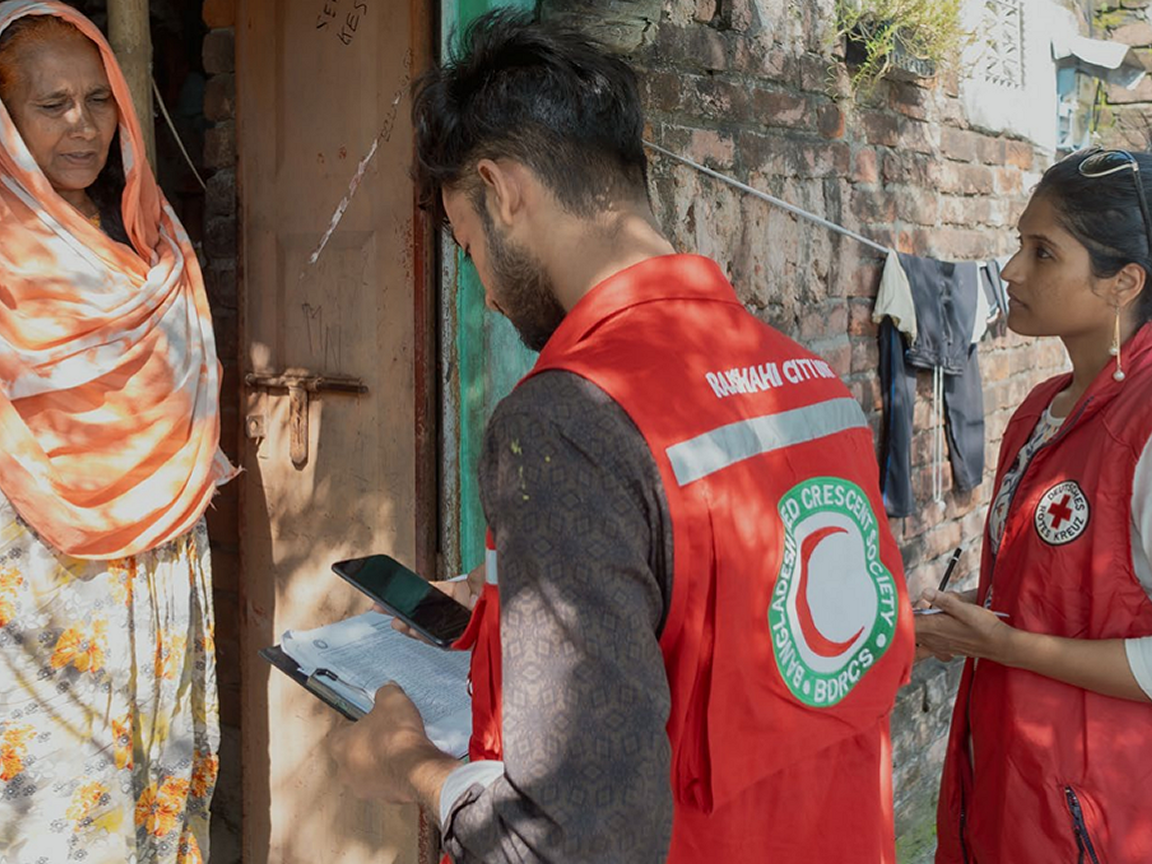
Post-simulation monitoring in Ward 4 Rajshahi, Bangladesh, which demonstrated that anticipatory cash transfers can be implemented through existing social protection systems. (Bangladesh Red Crescent)
Post-simulation monitoring in Ward 4 Rajshahi, Bangladesh, which demonstrated that anticipatory cash transfers can be implemented through existing social protection systems. (Bangladesh Red Crescent)
Our work on social protection became even more relevant in 2025 as we continued to shape, engage with and advocate for stronger mechanisms that bridge humanitarian and government programming, and effectively enhance the resilience of vulnerable communities to climate change.
We designed and supported a simulation of anticipatory shock-responsive social protection in Rajshahi city, Bangladesh. In August 2025, the Bangladesh Red Crescent Society, in close collaboration with government social protection and disaster management actors, carried out cash transfers using social protection beneficiary lists, targeting hundreds of elderly people vulnerable to heatwaves.
As joint lead of the USP2030 group, we contributed to the Belém declaration on hunger, poverty and people-centred climate action that calls for increasing investment in climate-related social protection to support vulnerable groups.
Through our collaboration with the UK Institute of Development Studies, we jointly authored a brief on climate change, conflict, food security and social protection in Niger, contributing evidence and practical approaches to understanding these interconnected challenges.
It introduced “opportunity storylines” as a forward-looking tool to explore the impacts of plausible climate futures and identify how social protection can reduce hunger, protect livelihoods and strengthen resilience.
As the UK-supported Clima-Social project in Burkina Faso and Mauritania concluded in 2025, we helped close a critical gap: connecting social protection and meteorological actors and making forecasts accessible to the people who need them most.
We helped build the capacities of national meteorological offices through targeted training and seasonal forecasts enriched with information on probable impacts, giving social protection beneficiaries time to prepare.
Conflict
‘Funding cuts are severely limiting our ability to protect refugees and displaced families from the effects of extreme weather. If we want stability, we must invest where people are most at risk’
– Filippo Grandi, UN High Commissioner for Refugees
Our priorities in 2025 were aimed at enhancing the capacity of Red Cross Red Crescent partners to integrate climate action in conflict-affected areas, engaging in innovative research to advance knowledge, and ensuring the climate-conflict relationship is high on the policy agenda.
The year was highly productive and impactful across our team’s work in climate and conflict. Our engagement with the ICRC continued strongly and we organized awareness sessions and training for more than 350 ICRC staff in, amongst others, Ethiopia, the Philippines and Venezuela.
We supported ten ICRC delegations in the Asia, Africa, the Middle East and North Africa (MENA), and the Americas with forecast interpretation and analysis of climate risk and compounding impacts.
The team also played an important role developing the ICRC’s Special Appeal 2025, including country plans for 14 delegations, launching its Catalogue of Climate Action, and supporting climate integration in its current planning for results cycle.
Demand for operational support has increased, and the conflict team is now more embedded in operations, taking on core coordination tasks. We believe our support helped ICRC teams make more informed, climate-smart interventions across a variety of sectors.
Our Operational prioritization tool for the impact of conflict and climate is a multi-year programme that helps ICRC teams navigate complex risk environments where climate impacts, conflict, and humanitarian needs overlap.
In Somalia we pioneered a new prioritization support index, using seasonal calendars and forecast support in an interactive tool that supports decision-making and prioritization at delegation level.
With the Anticipation Hub and the International Water Management Institute we jointly wrote the Toolkit for anticipatory action in fragile, conflict- and violence-affected settings (FCV), which consolidates experience from a range of organizations and has informed capacity building, including through its integration into the Movement’s updated Anticipatory Action Manual.
We developed a screening tool for the Norwegian Refugee Council to integrate climate risks into its operations. This work was built on the Climate Centre’s expertise developed over multiple partnerships with operational humanitarian organizations. The tool enhanced the integration of climate risks like flooding, drought and cyclones into NRC decision-making.
In May we jointly led a technical workshop in Madagascar for the Resilience and Preparedness to tropical cyclones across Southern Africa project. Using real-world community contexts, the team refined storylines and stress-testing methodologies which were field-tested by REPRESA, focusing on early warning for cyclones in Madagascar, Malawi and Mozambique.
These methodologies will be further developed over the next six years in our new large-scale research project CLIMARES, led by the International Institute of Social Studies, which began in September 2025.
In collaboration with the World Bank, storylines and scenarios were applied in the Gambia in support of climate risk modelling for priority sectors and future reporting to the bank.
We delivered new knowledge products on loss and damage and social cohesion in Niger, including a storymap and a short film (lead video) on non-economic loss and damage.
In our role as regional coordinator of the UK Met Office’s Weather and Climate Information Services MENA programme, we helped reinforce connections between national meteorological services and humanitarian actors to support anticipatory action and early response.
Together with the IFRC we led a regional workshop in Bangkok on anticipatory action in FCV settings in the Asia-Pacific region, and supported a similar UN-led workshop in Nairobi.
In partnership with the German Red Cross in Berlin, we organized an FCV-related training workshop on disaster risk reduction as part of a larger capacity building effort for the Movement.
With the UK Met Office and the British Red Cross, we organized a workshop in London on complex climate risk and climate security – a scoping exercise which informed a paper submitted to the Global Environmental Change journal.
We lectured at various universities, participated in a Chatham House round table on compound and cascading risks, engaged in foresight exercises on systemic risks through the Accelerator for Systemic Risk Assessment, contributed to global policy discussions at the Berlin Climate and Security Conference, the UN climate talks, and other major events, and with UK-based ODI Global we led a WMO round table.
All of this engagement was intended to broaden the sector’s understanding of the intersection of climate and conflict globally.
Mapping refugees’ and IDPs’ exposure to climate-related hazards was among our published research (and one of the most widely read contributions of the year) and we contributed to a new guide on stress testing.

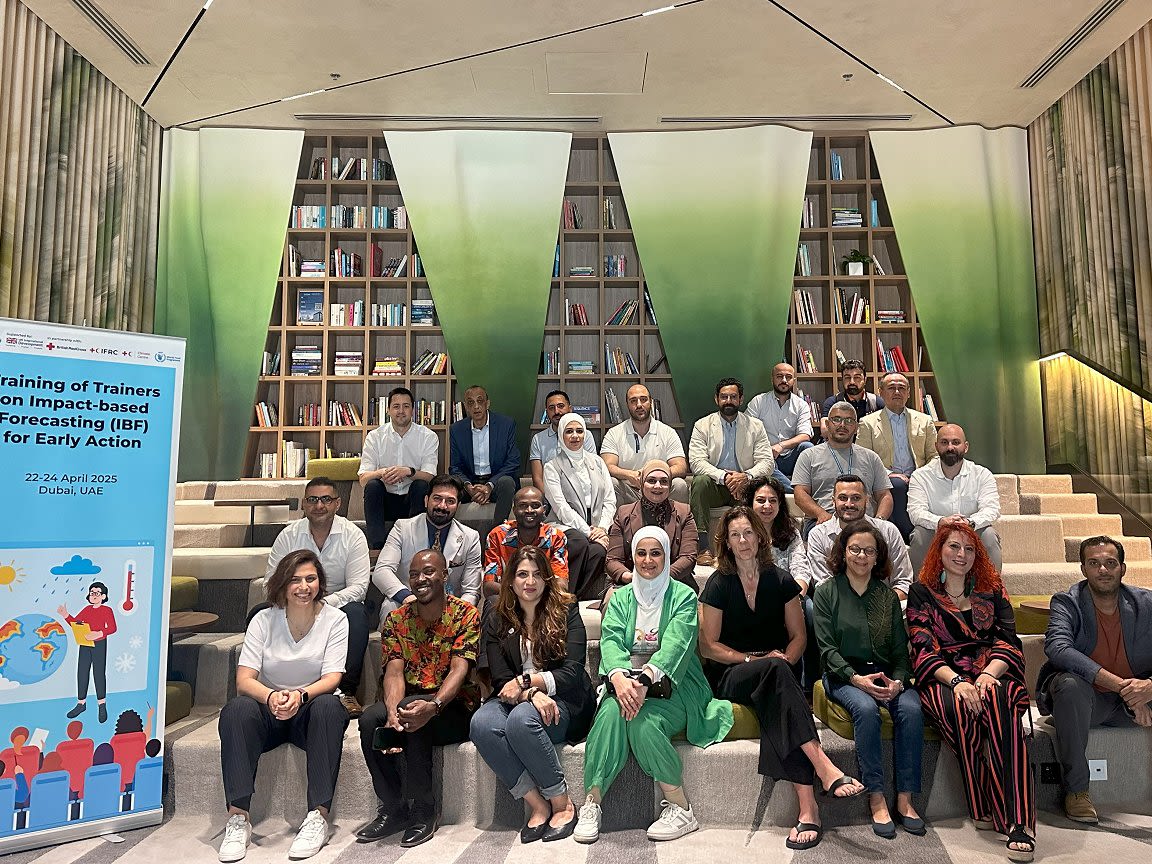
A report from Paris by the Climate Centre’s Karine Zoghby detailed a training session in Dubai on impact-based forecasting that involved 24 professionals from across the MENA region. (Climate Centre)
A report from Paris by the Climate Centre’s Karine Zoghby detailed a training session in Dubai on impact-based forecasting that involved 24 professionals from across the MENA region. (Climate Centre)
Locally led adaptation
‘Almost all adaptation in Europe is currently undertaken by local and regional authorities’
– Fleur Monasso and Sayanti Sengupta, 21 October blog
In 2025, the Climate Centre and the IFRC advanced the Climate Action Journey, which integrates climate risks into existing humanitarian programmes and expands locally led adaptation (LLA).
Our work has increasingly shown that vulnerability shaped by poverty, exclusion, and the growing impacts of humanitarian crises remains the greatest barrier to preventing people adapting to climate change, but their efforts are most meaningful when they are led at the truly local level.
Through the IFRC Global Climate and Resilience Pooled Fund, nine National Societies across Africa, Asia Pacific and Latin America received financial support to facilitate LLA through the Climate Action Journey.
In addition, we wrapped up the CAJ with five National Societies in Central Asia and Central Europe and added journey components to Water at the Heart of Climate Action (WHCA) project countries in Africa.
In the CAJ countries, National Societies are ensuring that communities are empowered to address their changing climate risks by analysing their vulnerabilities, designing adaptation actions inclusively, and leading the implementation of their own adaptation solutions.
Our methodologies centre on community leadership to assess, design and implement adaptation and promote partnerships that strengthen community decisions and the design of adaptation.
The CAJ in Nigeria, first rolled out since 2023, for example, includes four communities in Jigawa State and demonstrates how locally led approaches can translate climate awareness into tangible resilience.
Through a community-driven assessment, households identified drought, desertification, and erratic rainfall as their most pressing risks, and prioritized actions to strengthen livelihoods, environmental management, and preparedness.
One of the most significant changes is in women’s financial inclusion and household resilience. Through mothers’ clubs and village savings and loans associations, women are now saving, accessing small loans, and investing in alternative income sources.
This has enabled households to better cope with climate shocks such as crop losses, while also strengthening women’s confidence and decision-making power.
At the same time, communities are beginning to shift from reactive coping to anticipatory action, using seasonal climate information to plan ahead, adjust planting calendars, and prepare for dry periods.
Farmers are also adopting climate-smart practices through field schools, experimenting with improved soil management, drought-resistant crops, and agroforestry.
Without being locally led, climate change adaptation will not serve those most vulnerable to climate change, this 2025 joint publication with the IFRC argued. (IFRC)
Without being locally led, climate change adaptation will not serve those most vulnerable to climate change, this 2025 joint publication with the IFRC argued. (IFRC)
These changes reflect a growing willingness to innovate and adapt to changing conditions.
In parallel, communities are showing strong engagement in ecosystem restoration, identifying degraded land and planning initiatives such as tree planting and land rehabilitation, demonstrating the link between environmental health and long-term livelihoods.
Another inspiring example through the WHCA comes from the Ethiopia Red Cross Society, a CAJ pioneer. ERCS branches worked on adaptation solutions for water points, ensuring proper governance, community ownership, and collaboration with experts and organizations led to climate-smart, sustainable solutions.
The National Society helped communities define how water sources can cope amid increasing climate impacts when communities regularly suffer from too much water or too little, linking environmental protection and ecosystem management.
An IFRC evaluation of how the Climate Action Journey was perceived by National Societies showed they saw the value of the methodology and appreciated the shift toward empowering communities.
The method was considered instrumental in advancing climate action across National Societies by fostering a cross-sectoral approach, linking national and local knowledge and combining scientific and indigenous information.
The practical tools are considered to be effective, adaptable and scalable across different contexts, and the CAJ seems to be driving new engagements and partnerships effectively.
At the end of the year, we brought our key lessons to the UN climate talks in Brazil, where we expanded our global collaborations, pushing for increased financing and implementation.
The journey will evolve in 2026 towards a 2.0 version to reflect the findings of the evaluation and experience so far, and implementation will continue in Belize, Burkina Faso, The Gambia, Ghana, Guyana, Kiribati, Tanzania and Vanuatu.
Urban
Dhangadhi residents say extreme heat has become a significant threat to their well-being, with health, social, economic, and environmental consequences’
– Ramiz Khan, Climate Centre, 2 June Heat Action Day news
This year the urban team continued to advance work on heat action in cities and focused on strengthening the capacity of the Red Cross Red Crescent Movement to work on urban adaptation.
We initiated a second edition of the urban climate fellowship programme which guides fellows through a 16-week course on urban climate resilience. We received over 100 applicants from National Societies around the world and were able to accept 30 fellows, of whom 25 graduated from the programme.
This fellowship is essential to strengthen Movement capacity to develop and implement urban adaptation, and many of the alumni from the first edition have become excellent partners, leading urban climate work in National Societies.
Unfortunately, our main source of funding for heat and coastal activities, the USAID-funded CoCHAP programme was halted in January and subsequently cancelled in February; but a one-year grant from the Quadrature Climate Foundation allowed us to continue work on heat risk perception, early warning and policy.
Through this grant, we launched our flagship report Heat Through the Eyes of the Most Vulnerable that builds on heat risk perception surveys conducted as part of CoCHAP and provides a bottom-up perspective on challenges and solutions.
It highlights critical gaps in risk perception such as a lack of understanding of the worst consequences of extreme heat, and the reasons why many well-meaning programmes fail to be accessible to those who are truly the most vulnerable.
Fleur Monasso blogged from the Portugese city of Braga where Red Cross volunteers check on elderly residents as part of a wide-range of activities supported by local business. (Portuguese Red Cross)
Fleur Monasso blogged from the Portugese city of Braga where Red Cross volunteers check on elderly residents as part of a wide-range of activities supported by local business. (Portuguese Red Cross)
To raise awareness for heat risks and action, we organized the fifth annual Heat Action Day on 2 June with activities in over 300 locations around the world centred on the theme of recognizing the signs of heat-related illnesses.
These included events organized by National Societies, governments and other partners, including art contests, heat runs, regional heat webinars and seminars, workshops, children, women and the elderly, water distributions, cooling stations, and social media campaigns.
The day took on a life of its own, with media reports indicating actions by groups that we had not even been in contact with (the New York governor’s office, for example).
To further spread the message on heat action, we convened experts in Bangkok, Delhi, Kampala and Tanzania to provide input to a new handbook released by the World Bank in September.
To foster innovations in design and architecture that accounted for extreme heat, we launched the Heat Adaptive Architecture Design Competition and received 31 submissions from different regions, of which the top ten candidates received mentorship in the next phase.
Through the CASCADE project, the Climate Centre helped organize and facilitate city learning labs in Accra, Harare and Kampala, bringing various urban stakeholders together to explore climate and health challenges, identify research gaps, and propose solutions.
Attribution
‘This heatwave [in Norway, Sweden and Finland] was a stark reminder of the threat of climate change in cold-climate countries that aren’t normally considered vulnerable’
– Maja Vahlberg, Climate Centre Technical Adviser for Attribution
In 2025 the attribution programme helped people understand the role of climate change in 21 extreme weather events around the world, and was aimed at leading to outcomes or adjustments at the level of national climate policy.
As part of the World Weather Attribution partnership, we published a study on the role of climate change in the deadly Los Angeles wildfires in January.
In March we published three studies on the influence of climate change on heat in South Sudan, floods in Botswana, and a compound heat and flood event in Argentina.
We followed this with three studies in April showing that climate change made weather conditions leading to wildfires in South Korea about twice as likely, that Kinshasa’s deadly floods were mainly driven by vulnerability and exposure factors rather than unusual rainfall, and that an extraordinary March heatwave in Central Asia was up to 10°C hotter due to climate change.
In May we found that climate change increased the heavy rains that led to flooding in the central Mississippi river valley, though effective emergency management limited impacts.
In June we showed that climate change drove record-breaking heat in Iceland and Greenland, threatening cold ecosystems, and that warmer summer days in England have increased.
In July we highlighted how growing exposure and uncertain rainfall trends are increasing risks in Colombia.
In August we found that climate change intensified monsoon rains that worsened floods in Pakistan, made a two-week Fennoscandia heatwave hotter and more likely, and increased the likelihood of wildfire conditions in Cyprus, Greece and Türkiye by a factor of ten.
In September we showed that extreme fire-weather conditions in Spain and Portugal have now become common due to climate change.
Climate change enhanced the intensity of Hurricane Melissa in October 2025, testing the limits of adaptation in Jamaica and eastern Cuba, a World Weather Attribution study concluded. Pictured, the Cuban Red Cross delivering tools, kitchen supplies and hygiene kits to affected families affected Granma province last November. (Photo: Cuban Red Cross)
Climate change enhanced the intensity of Hurricane Melissa in October 2025, testing the limits of adaptation in Jamaica and eastern Cuba, a World Weather Attribution study concluded. Pictured, the Cuban Red Cross delivering tools, kitchen supplies and hygiene kits to affected families affected Granma province last November. (Photo: Cuban Red Cross)
Finally, in November, we found that climate change made both Hurricane Melissa and the five-year Iran drought more likely but drew an inconclusive result in a study of floods after extreme rainfall in Mexico.
Overall, this work makes climate change tangible, giving a scientific answer about the role of climate change and other factors in driving the extreme weather and impacts that the public is experiencing.
To further explore the use of attribution information, we organized two policy workshops. We visited the Spanish Red Cross in Madrid to discuss extreme heat, floods, and wildfires and organized a virtual policy dialogue on extreme heat in Europe and Central Asia, including panellists from National Societies in the Portugal, Spain, Sweden, Tajikistan and the UK. These dialogues explored the implications of attribution studies for policy areas including energy, construction, agriculture and land use.
This year we participated in a US National Academy of Sciences workshop on the use of attribution findings in humanitarian work – an input to the upcoming NAS report on state of attribution science generally.
We also developed research on attribution as part of the COMPASS research project by publishing a paper with guidance on integrating qualitative vulnerability information into attribution studies, and developed case studies on attributing compound extreme weather events to climate change in Honduras.
This research continues to encourage the attribution science community to factor in vulnerability, exposure and response into their conceptualization of risk, making their assessments more attuned to the real world.
Early action
‘Anticipatory action closes the gap between “we knew” and “we acted”’
– IFRC Secretary General Jagan Chapagain at the 13th Global Dialogue Platform on Anticipatory Action

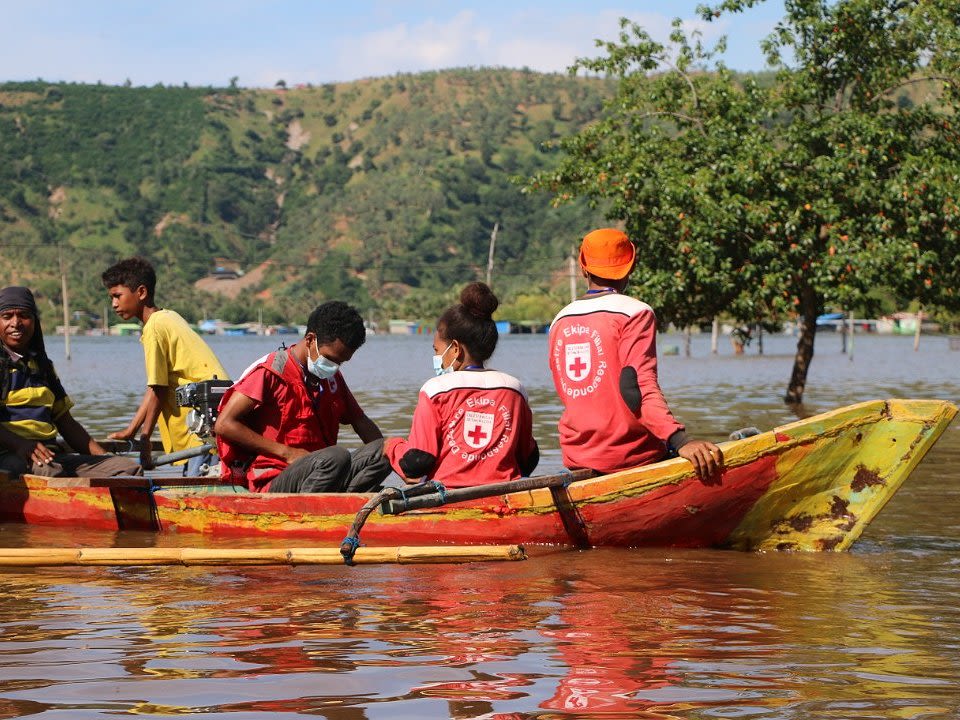
Florence Pichon called in a blog from Bangkok for early-warning systems to be backed up by proper financing strategies, coinciding with a Climate Centre-FAO report on the potential of a special financing mechanism for Anticipatory Action in Timor-Leste. Pictured, flood response and evacuation in Dili after Cyclone Seroja in April 2021. (CVTL)
Florence Pichon called in a blog from Bangkok for early-warning systems to be backed up by proper financing strategies, coinciding with a Climate Centre-FAO report on the potential of a special financing mechanism for Anticipatory Action in Timor-Leste. Pictured, flood response and evacuation in Dili after Cyclone Seroja in April 2021. (CVTL)
The Climate Centre helps the Red Cross Red Crescent Movement and its partners design anticipatory systems for weather and climate-related disasters, ensuring that established triggers activate early action protocols with ring-fenced funding.
In 2025, we supported at least 50 National Societies with EAPs, of which those for (alphabetically) Ethiopia, Kenya, Kyrgyzstan, Malawi, Mozambique, the Philippines, Somalia and Yemen were activated.
Through the Anticipation Hub, we contributed to the 2025 global overview report that demonstrated the growth of anticipatory action the previous year: activations overall have increased from 98 in 2023, supporting 11 million people, to 121 in 2024 supporting 17 million.
We provided forecast support to the ICRC and IFRC for developing Hurricane Melissa and this real-time information was helpful to the Movement’s response, along with media commentary on its scale and impact.
We provided guidance on extreme heat to National Societies in West Africa, and IFRC delegations integrated this into their risk watch to inform anticipatory action and response.
As part of the push for the institutionalization of anticipatory action, we contributed to national road maps in South Sudan, Uganda and the MENA region, and supported the Nepalese government in developing legal and operational frameworks.
We supported capacity building to advance impact-based forecasting and anticipatory action for internally displaced persons in MENA, contributing to a growing pool of resources for the region.
We conducted the evaluation of the IFRC operational framework for anticipatory action, and the findings have informed the next edition of the EAPs and a review of other tools. (The EAP 2.0 model, expected to scale up anticipatory action by providing National Societies with new fund-raising options, is currently under review.)
Throughout the year, we contributed to research and published articles on disease outbreak preparedness, unprecedented weather, the 2023 Canadian fire season, as well as storylines and the WFP’s evidence base on Anticipatory Action 2015-2024; we facilitated regional dialogue platforms in MENA, Asia and the Americas and the global dialogue platform in Berlin.
Youth
‘Youth are ones that can really make a difference on this threat to all of us’
– IFRC President Kate Forbes at the youth climate summit
Youth engagement remains a key element for effective and impactful climate action across the Red Cross Red Crescent network.
In 2025, the Climate Centre strengthened opportunities for meaningful youth participation, leadership and collaboration, creating a platform for young people to share solutions and inspire climate action in their communities.
A key achievement was the successful delivery of the Climate & YOUth Summit 2025, From the Ground Up: Youth for Awareness, Action and Advocacy, which mobilized young people from across the Red Cross Red Crescent and other youth-led organizations to advance climate awareness, action and advocacy.
At least 1,800 people registered to take part, representing 54 countries, contributing not only as participants but also as speakers, facilitators and organizers.
The summit delivered learning sessions, plenary discussions and networking spaces that showcased youth leadership and innovation in climate action and intergenerational collaboration, and enabled participants to build connections and exchange experiences.
The sessions were led by young people from National Societies and partners from the Global Youth Mobilization Big Six (GYM), with sessions in English, Spanish and French.
Youth leadership was ensured by a steering committee to advise on the design and promotion of events, bringing together young representatives from the National Societies of Japan, Lebanon, Mauritius, Nepal, and St. Lucia, the IFRC Youth Commission, and GYM.
This continued investment in youth-led participation extended the reach of the summit, which was supported by the IFRC secretariat, the American Red Cross and GYM.
The Climate Centre continued to strengthen the Y-Adapt curriculum, focusing on enhancing youth skills through the development of a new project management module for National Societies, also supported by the American Red Cross.
As part of the UK Met Office WISER project, the social protection team conducted research on livelihoods in Burkina Faso and Mauritania at risk from heatwaves, droughts and floods.
Their study focused on identifying options that can support climate adaptation and strengthen resilience among vulnerable populations. It examined how increasing climate risks are impacting households engaged in crop farming, livestock rearing, and gold mining while considering differences across wealth groups, young people, women, and the elderly.
Young people were at the centre of the research as they are often disproportionately exposed to climate-related livelihood risks and face heightened barriers to adaptation – with implications for targeted social protection.
The team recruited three interns based in Burkina Faso and Mauritania in 2025 to strengthen youth engagement and support capacity building; they contributed to field-based activities like data management and translation.
We recruited seven other interns in 2025, and our internship programme aims to strengthen capacity building for young people and create opportunities in the climate and development space for students and early-career professionals.
We began establishing a fellowship programme with the University of Colorado Boulder, to be launched in 2026, in memory of Pablo Suarez, reflecting his commitment to creating opportunities for emerging professionals.
Together, these achievements demonstrate the growing influence of youth-led climate action across the Red Cross Red Crescent, and reinforce the importance of sustained investment in young people as drivers of innovation, leadership and climate resilience.

Participants shared both their expectations for the Climate & YOUth Summit 2025 and their thoughts afterwards on a live Miro board. (Climate Centre)
Participants shared both their expectations for the Climate & YOUth Summit 2025 and their thoughts afterwards on a live Miro board. (Climate Centre)
Innovation
‘I was glad to learn that the IFRC-Climate Centre innovation booth became a real hotspot, proving again that a little bit of creativity goes a long way in sparking meaningful dialogue’
– Climate Centre Director Aditya Bahadur at the Global Platform for Disaster Risk Reduction in Geneva

The Climate Centre hosted the second regional learning assembly of Water at the Heart of Climate Action, intended to ensure good collaboration between key players on national and international levels. (Climate Centre)
The Climate Centre hosted the second regional learning assembly of Water at the Heart of Climate Action, intended to ensure good collaboration between key players on national and international levels. (Climate Centre)
The Climate Centre continued to embed innovation into its ongoing work, finding creative ways to support candid multi-stakeholder dialogue to advance effective adaptation.
In collaboration with partners, the Climate Centre engaged with communities across the River Nile basin in (alphabetically) Ethiopia, Rwanda, South Sudan, Sudan and Uganda through Water at the Heart of Climate Action.
We hosted the programme’s second regional learning assembly, intended to promote collaboration between all key players on national and international levels – ensuring that we are working across the early warning value chain from data collection to community action.
With diverse stakeholders and organizations present, we applied innovative methods such as cardboard theatre, learning marketplaces, applied improvization and podcasts to generate stories about water, risk and resilience.
The Climate Centre team also supported the Climate Action Journey in WHCA countries, laying the foundation for effective early warning systems.
We conducted dialogues about the future of anticipatory action and sharing these insights through an art installation at the Global Dialogue Platform in Berlin in December. Our mural depicted insights and informed the dialogue during the three-day conference.
During the gathering itself, cartoon artists and delegates worked side by side to capture diverse future visions for anticipatory action. The resulting pieces were assembled in a sculpture at the closing ceremony of the platform.
Complex dialogue needs to be carefully designed and facilitated, and developing capacities in this realm is crucial. The Climate Centre started a new fellowship programme to support this in Africa and Asia, focusing on professional facilitators.
In early 2025, in work supported by the UK and Canada, we took in two cohorts of 20 fellows each from South Africa, Uganda and Zambia, and from Bangladesh, Nepal and the Philippines. Through retreats, online lectures and mentoring, they learnt new techniques and experimented at workshops for their use in their country contexts.
The fellowship programme spawned to two new card-based games: Imagine Adaptation, exploring adaptation itself, and Feel Adaptation, delving into the emotions that often accompany climate work. Both games were widely used and distributed globally, infusing global dialogue such as the UN climate talks and the Global Platform for Disaster Risk Reduction.
We published a collection of 50 short games in a card deck, Adaptation Connect, that was shared with a wide range of partners including National Societies and Universities.
We also developed a cartoon-infused stress-testing guide to explore ways to assess the robustness of adaptation strategies to compound and cascading risk, published under the PARATUS project.
Communications
'The rain used to come without warning. Now the message comes before the clouds'
– Tea farmer, Karongi district, Rwanda
Basic Google Analytics showed the monthly audience for our website expanding slightly over the course of the year: from 2,100 unique views in January to 2,600 in December, with an annual average of 2,200, helping with the comms objective of securing the widest possible dissemination of our research, and fulfilling our IFRC mandate of supporting National Societies and improving our collective humanitarian impact.
That audience is concentrated in the anglosphere, above all in the US, and countries where English is the first language or a widely spoken second language. We continue to try to expand this underlying reality – short of devoting significant resources to translation and a multilingual site – with publications like our Training report on impact-based forecasting: a facilitation guide (Arabic), for example.
The Climate Centre’s January 2025 analysis of the science behind the devastating wildfires in California has turned out to be the most widely read news story in the recent history of our website, and by some margin.
The Climate Centre uses LinkedIn and other social media platforms to share insights on climate-related risks, humanitarian action, and emerging research with practitioners, partners, and decision-makers around the world. We promote publications, events, and resources, helping to start conversations and encourage exchange across the humanitarian and climate communities.
Our current LinkedIn following of 27,491 helped to generate nearly half a million non-unique Impressions in 2025, with 5,441 Reactions, 404 Comments and 26 Reposts in total for the period June 2025 to June 2026 – suggesting a high degree of visibility but a relatively low engagement rate. Our X/Twitter audience has stalled, like others have, and it has not grown above 11.2k for at least two years, still roughly triple the next two biggest IFRC reference centres.
We generated 114 web news stories over the course of the year, including our usual round-up of the year in December. Bylined blogs kicked off with a piece by Roop Singh who wrote that compound events in which two or more hazards such as heatwaves and floods occur simultaneously or in close succession are becoming more common.
The American Red Cross Los Angeles chapter was at work nearly 24/7 to support the thousands of people displaced from their homes by the January wildfires, and a blog by Liz Stephens and Andrew Kruczkiewicz on the science behind the fires was the most widely read news story of recent years. (American Red Cross)
The American Red Cross Los Angeles chapter was at work nearly 24/7 to support the thousands of people displaced from their homes by the January wildfires, and a blog by Liz Stephens and Andrew Kruczkiewicz on the science behind the fires was the most widely read news story of recent years. (American Red Cross)
In a blog from Bangkok, Florence Pichon examined the potential of a special financing mechanism for anticipatory action in Timor-Leste; Fleur Monasso – on a visit to Portugal – wrote about a major climate event organized by the Braga branch of the Portuguese Red Cross for World Red Cross Red Crescent Day on 8 May; Tilly Alcayna introduced her examination of how infectious diseases are affected by climate factors; Sayanti Sengupta joined other co-chairs of the USP2030 Working Group on Social Protection and Climate Change to write a blog welcoming the link drawn between climate action and social development for the world summit for social development in Qatar; and from Antananarivo Dorothy Heinrich and Liz Stephens advocated factoring scenario planning into the design of anticipatory action, already used in the humanitarian sector in desktop exercises and simulations to sharpen decision-making.
With January confirmed as the 18th in the previous 19 months when the global average temperature was more than 1.5°C above the pre-industrial level, Aditya Bahadur said in an interview with the Finnish Red Cross that “[w]e have entered uncharted territory. The natural and weather systems of the Earth are now changing rapidly in ways we do not fully understand.”
Among our other direct media engagement, Catalina Jaime told Colombia’s El Espectador newspaper her contribution to the IPCC’s seventh assessment of the global climate would centre on adaptation amid fragility and poverty.
ESRI’s Olivier Cottray interviewed Cornelia Scholz about her work with the ICRC Mali delegation to develop a borehole stress index that will enable water engineers to base decisions on where to drill on combined environmental and security risk instead of even educated guesswork.
A multimedia highlight of the year came when – through Director of Programmes Julie Arrighi – we were granted limited access to winners of a photo contest run by the Global Heat Health Information Network depicting extreme heat – traditionally a difficult area to illustrate.
The IFRC continued to cross-promote our output while we did likewise with theirs (example).
Finance
The Climate Centre – an independent foundation under Dutch law – remains grateful to its hosts the Netherlands Red Cross, which also assists with human resources and legal affairs.
We were supported last year by the European Commission, the ICRC and the IFRC secretariat or their delegations and these National Societies, in each case with the financial support of their public or governments (alphabetically):
American Red Cross
British Red Cross
Danish Red Cross
Finnish Red Cross
French Red Cross
Georgia Red Cross
German Red Cross
Irish Red Cross
Luxembourg Red Cross
Netherlands Red Cross
Norwegian Red Cross
Swedish Red Cross
Other contributors were (alphabetically):* AtkinsRealis UK International, Bezos Earth Fund, Centre National de la Recherche Scientifique, CGIAR, (UN) Complex Risk Analytics Fund, Deltares, Dimos Egaleo, Dutch Research Council, European Research Executive Agency, Institute of Development Studies, International Development Research Centre, (UK) Met Office, MSF Switzerland, Norwegian Refugee Council, Norwegian Research Centre, Oxford Policy Management, People in Need, Quadrature Climate Foundation, Rockefeller Foundation, Start Network, Swiss Church Aid HEKS/EPER, UNDRR, UNEP, Wellcome Trust, WFP, and the World Bank.
We are also grateful for contributions from these universities: Bristol, Cape Town, Reading, Toronto, and VU (Amsterdam).
A full financial statement will be available in our hard-copy report later this year, along with an infographic summary to be added here.
As always, we thank our donors for their generous support.
*Includes agencies best known by their acronyms.
 Built with Shorthand